|
Alpha-Theta Training for Chronic Trauma
Disorder,
A New Perspective -- Section III. Toward A Synthesis
TABLE OF CONTENTS
III.
TOWARD A SYNTHESIS
A. A MULTILEVEL MATRIX
B. COEX SYSTEM
C. THE TRANSPERSONAL DOMAIN
TOWARD A SYNTHESIS
Section II of this chapter covered views of the effectiveness of
neurotherapy from the viewpoint of generally accepted constructs in
psychology, that is, varying states of arousal associated with different EEG
frequencies, state- and context-dependent learning and memory, and effects
of early stress and trauma on subsequent development and behavior. These
perspectives on the effectiveness of the alpha-theta protocol seem to have
common threads which lead to the possibility of a synthesis. To get to that
point it is important to view these seemingly disparate approaches not as
isolated viewpoints, but as parts of a system. In this section I attempt to
do this by first discussing the concept of chronic trauma disorder.
Colin
Ross (1989), an authority on multiple personality disorder (MPD), writes
that the Diagnostic and Statistical Manual (American Psychiatric
Association, 1994) should have a category for chronic trauma disorder, of
childhood or adult onset, with and without MPD. This would be a hierarchical
diagnosis of which currently disparate diagnoses are a part, with persons
who had been most severely abused earlier in life and who developed
dissociation as a defense becoming MPD. Those who were less severely
traumatized (or less "gifted" at dissociation) might develop somatic
symptoms, personality disorders, panic disorders, depression, and/or
addiction, all probably exacerbated by genetic predispositions.
Ross
(1989) analogized that chronic trauma disorder is a single field, with
distinct regions. These different regions are called affective disorder,
eating disorder, substance abuse, and so on. Numerous regions of the field
can be activated simultaneously in a given patient. These subregions can
occur in different combinations in different patients. From this point of
view, chronic trauma disorder could be seen as a single diagnostic entity.
Following such reasoning, the core issue (the chronic trauma) may be hidden
in one's unconscious, and may be viewed as permeating all levels of the
self: physical, mental, emotional, and spiritual. Thus, childhood trauma
would become the source out of which multiple symptoms and disorders flow.
Relatedly, results of acute trauma in adulthood would correspond to PTSD.
Severity and chronicity of previous trauma could account for the varying
severity and multiplicity of diagnoses seen in clients. Perhaps a core
diagnosis of trauma disorder would be most appropriate, with modifiers of
acute versus chronic, childhood versus adult onset, and with or without
dissociative features.
We all
have experienced some degree of trauma or "wounding." That is, we all were
born small, helpless, and dependent in a world of giants who controlled our
lives and abused some of us. How could we escape some trauma at an age where
we may not have been permitted, or had the opportunity, to process events of
emotions and, in most cases, were not capable of processing them had we been
allowed to? So, in this view, each of us carries with us core issues based
on earlier trauma that helped form the foundation of present and future
patterns of beliefs, reactions, and emotions. The more deeply wounded carry
with them repressions that manifest themselves as symptoms leading to
multiple psychiatric diagnoses.
In the
following paragraphs I attempt to explain how the alpha-theta neurofeedback
protocol may be effective in overcoming or ameliorating trauma disorder. In
doing this, there will be some reiteration and elaboration of ideas
presented in Section II, along with introduction of some additional ideas
mainly from the field of transpersonal psychology.
A. A MULTILEVEL
MATRIX
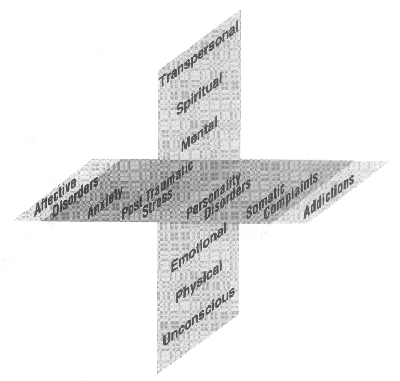
The
Peniston protocol (Peniston & Kulkosky, 1989), initially focusing on the
reduction to elimination of addiction, has, in my opinion, created a
multilevel matrix approach that can simultaneously treat multiple diagnoses
such as affective disorders, anxiety, post-traumatic stress disorders,
personality disorders, and some somatic complaints along with addiction. As
shown in graphic form in Fig. 13.1, 1 perceive these disorders as ranging
along a horizontal continuum. Juxtaposing certain aspects of self-the
unconscious, physical, emotional, mental, spiritual, and transpersonal
aspects in this case-along a vertical axis creates a multilevel matrix
describing the potential reach of this protocol. Computerized EEG feedback,
a therapeutic relationship between patient and clinician and the imagery of
desired outcome, succeeds in interfacing technology with compassionate
personal contact. I believe this protocol concurrently affects the physical
addictions, the underlying neurological conditions, psychological states,
and the client's spiritual nature.
Major
details of the dynamics of this matrix of intervention may be further
understood by considering concepts such as COEX systems, and various
concepts from the transpersonal domain.
FIGURE 13.1
The Peniston protocol creates a multilevel matrix of intervention with its
horizontal axis of diagnoses and presenting problems and its vertical axis
of levels of the Self and Self connected to All That Is.
B. COEX SYSTEM
In
deeply altered states, when people experience abreactions and flashbacks,
they are encountering what some refer to as the psychodynamic realm.
These experiences are associated with and derived from material from the
subject's life, particularly from emotionally highly relevant events,
situations, and circumstances. They seem related consistently to important
memories, problems, and unresolved conflicts from various periods of the
individual's life since early childhood. These flashbacks can take the form
of reliving memories of traumas not accessible in normal states of
consciousness. The memories may take the form of a variety of experiences
that reflect unconscious material in the form of symbolic disguises,
distortions, and metaphorical allusions, often presenting as hypnogogic
imagery that seems to spring into consciousness from unconscious sources.
This concept relates to the writings of Stanislav Grof (1976, 1980, 1985)
and his work at the National Institute of Mental Health with LSD
psychotherapy, another consciousness-altering type of therapy used in the
1950s and 1960s until the drug was scheduled by the federal government. Grof
offers the principle of specific memory constellations, for which he has
used the name COEX systems (systems of condensed experience). A COEX system
can be defined as a specific constellation of memories from different life
periods of the individual. The memories belonging to a particular COEX
system have a similar basic theme or contain similar elements, and are
accompanied by a strong emotional charge of related quality. The deepest
layers of this system are believed to be represented by vivid memories of
experiences from the period of birth, infancy, and early childhood, and seem
to represent a summation of the emotions belonging to all the constituent
memories of a particular kind. A given individual can have several COEX
systems. Entering the deeper state evoked by alpha-theta neurofeedback
training, with its apparent access to deeper layers of repressed emotion,
perhaps affords one the opportunity to confront certain COEX systems
containing unprocessed energies related to past trauma (state-dependent
retrieval).
In
"normal" or waking consciousness, in both our internal and external
perceptions, we experience ourselves as existing within the boundaries of
our physical body and are confined by the usual spatial and temporal
boundaries. We vividly experience our present situation and our immediate
environment. We recall past events and anticipate the future. We live in our
"life drama." In the training with feedback tones of a computerized EEG, as
the patient obtains deep alpha and theta states, there appears to be a
disidentification with the "ego self." It is within this state that many of
our clients spontaneously report experiences of flashbacks of earlier
forgotten and traumatic times, events that may have been etched in memory
systems because of their perceived survival value. From this detached state,
the intensity of the emotional reaction is greatly lessened. "Ego bracing"
is lessened to eliminated. In this state, which I call "suspended
animation," with the encounter with suppressed material facilitating inner
resolution of the earlier trauma, the personality system seems to move to a
higher order of functioning (White & Martin, 1998).
As
noted earlier, COEX systems are said to be specific constellations of memory
accompanied by strong emotional charges of related quality. When consciously
accessed, affect related to traumatic memories may be discharged (catharsis)
and neurochemistry modified in a positive manner. When trauma is "released"
in this manner, it may make it possible for new, more desirous "programs" to
be entered into the "unconscious" by way of the prescribed, intentional
imagery involved in the alpha-theta protocol.
If one
ascribes to the theory of chronic trauma disorder and to the idea that, as
children and perhaps as adults, all of us have lived on a continuum of
actual or perceived abuse, we all may have a need to explore related COEX
systems. What causes one to experience test anxiety or fear of talking
before groups? What causes the athlete to clutch in that moment when
ultimate performance is needed? Could it be anxiety of many possible
etiologies, most of which involve childhood adaptations? Many peoples' lives
show evidence of excessive fear of not being good enough, an obsessive need
to prove oneself, extreme need for approval, a perceived need to perform
extremely well, a need to be loved and accepted at any cost, or a need to be
number one, all possibly growing out of some early trauma related sense of
inadequacy and low self-confidence. While there could be as many degrees and
specific causes of these as there are people and childhoods, alpha-theta
neurofeedback may, for the reasons suggested earlier, have value in most
such cases.
To
summarize Section III thus far, alpha-theta neurotherapy seems to enhance
the ability of the brain to shift state. By encouraging the brain to move
toward the lower end of the arousal continuum, the protocol may access theta
state-dependent memories of early traumas, which when retrieved, can be
altered in a positive way, with accompanying positive changes in
neurochemistry.
C. THE
TRANSPERSONAL DOMAIN
While
the preceding paragraphs are an attempt to synthesize several views on
dynamics of neurofeedback, no examination of the effectiveness of the
alpha-theta protocol would be complete without commenting on the
transpersonal realm reportedly often encountered using this protocol.
Observations of the transpersonal realm are beginning to suggest that
consciousness is involved in the so-called material world in ways previously
unimagined (Grof, 1993). Amit Goswami (1993), professor of physics at the
University of Oregon, even offers the premise that consciousness creates the
material world. In any event, the material world and the world of
consciousness and creative intelligence, rather than being from two
distinctly different realms with discrete boundaries, appear to be engaged
in a constant dance, their interplay forming the entire fabric of existence.
This is echoed by physicist Nick Herbert, in his book Quantum Reality
(1985), and is a notion that is being confirmed in research by others in
modern physics, biology, thermodynamics, information and systems theory, and
other branches of science (Grof, 1993). Out of his government research with
4,000 patients in LSD psychotherapy in controlled settings and a further
20,000 "Holotropic Breathwork" sessions with people from all walks of life,
Stanislav Grof, M.D., formerly a professor at Johns Hopkins School of
Medicine, offers a cartography of inner space that transcends linear space
and time and includes, but goes beyond, one's individual biographical domain
to the transpersonal such as out-of-body experiences, spirit guides, visions
of light, sense of being pure energy in the cosmos, and so on. In general,
this realm moves beyond the Newtonian cause-and-effect world and parallels
ancient views of human consciousness that have existed for millennia.
Philosopher and writer Aldous Huxley called this the "perennial philosophy."
There are parallels with shamanism, the great spiritual philosophies of the
East (such as different systems of yoga), various schools of Buddhism or
Taoism, the mystical branches of Judaism, Christianity, and Islam, and with
many other esoteric traditions of all ages. This mystical reality is said to
bring knowledge and insight from sources beyond, and can happen in an
altered state if the barriers separating self from nonself become fluid, and
the imagination reaches beyond the intellect (Achterberg, 1985). Related to
this, it is not unusual for some neurotherapy patients to report
experiencing an "inner guidance." This takes many forms, on a continuum from
deep insight to the sense of another being or animal appearing to them.
Among
the transpersonal experiences reported by many alpha-theta neurofeedback
patients, three concepts seem to be especially common and facilitative of
major positive change. The first of these is what some have called the
"witness consciousness." In this phenomenon the client appears to be
transported into a suspended, objective state wherein he or she experiences
an observing self. Deepak Chopra (1989, 1993) offered a metaphor for this
type of process with a verse from an ancient Indian Upanishad: "A man is
like two doves sitting in a cherry tree. One bird is eating of the fruit
while the other silently looks on." This dimension of self seemingly is able
to experience and perceive a "bigger picture" of any original trauma,
enabling the patient to perceive from a broader domain and experience less
judgment and more acceptance. This capacity to go beyond the pain of the
original trauma seems to allow one to release and discharge prior
unexpressed emotional pain. There seems to be a carryover when the patient
returns to what one might call "normal" waking consciousness, with one then
living more in a state of acceptance of "what is" rather than how one wishes
it to be, and more able to "let go" of unwanted thoughts and feelings.
A
second concept is the "resource self." This seems to be an aspect of the
witness consciousness although there is a different quality to the
experience. Whereas the witness consciousness could be defined more as an
"observing self" that watches with interest and without judgment, the
resource self is experienced as the personal adult self available to the
child being abused in the abreactive flashback situation and becomes "his"
or "her" champion and rescuer. In essence, it seems the individual
incorporates the protective and nurturing "inner parent" for
representing/rescripting his life. A part of self thus is reclaimed that is
not the victim and can take care of and care for oneself.
The
third concept is that of the "inner healer." The deeply altered state of
consciousness that some neurotherapy practitioners term the "theta" state
may also produce this inner healer that "targets" somatic issues,
strengthens the immune system, and, otherwise, physically energizes the
subject (Schummer, 1995).
One
middle-aged professional man, who had no prior experience of the
transpersonal realm, reported during treatment that he had experienced a
guide that he referred to as his "higher power," which appeared in different
guises. Initially his guide appeared as a hawk. Frequently, the guide
appeared as a Native American who told him he was his great, great, great
grandfather (who was known to have been an American Indian). In one
alpha-theta session, the hawk reportedly appeared to him and took him on its
wings and soared out into the cosmos. From there, the hawk pointed out the
earth to him and then the pinpoint that was his home. He explained to him
the insignificance of his local reality in comparison to the vastness of the
cosmos. No sooner had he absorbed this idea, than he claimed he was quickly
propelled to earth where he was taken to the microcosm world of the
earthworm. It was then explained to him the significance and importance of
all things. Truth is often found in paradox (White & Martin, 1998). This
same man had had a difficult relationship with his father for most of his
life. They were not close and he did not understand his father and his
coldness. During one session, he was "taken back" in time to where he
reported experiencing that he was his father as a child. He returned to
normal waking consciousness with a new understanding and compassion for his
father (White & Martin, 1998). Again Grof (1993) confirms this: ". . .
people in non-ordinary states have reported that they experienced episodes
occurring long before their own conceptions. For example, many report being
able to enter the consciousness of their parents during their mother's and
father's childhoods and to experience through their parent's consciousness
events from that time."
To
help understand these transpersonal experiences that seem to positively
alter attitudes and create healings, one might turn to quantum physics,
which claims reality is an undivided wholeness and that, in spite of its
obvious partitions and boundaries, the world in actuality is a seamless and
inseparable whole (Herbert, 1985; Capra, 1975). Similarly, the English
physicist David Bohm states that one is led to a new notion of unbroken
wholeness, which denies the classical analyzability of the world into
separately and independently existing parts. The inseparable quantum
interconnectedness of the whole universe is the fundamental reality (Bohm,
1983). On the other hand, one might consider such experiences simply as akin
to dreams experienced in the altered state of sleep that, nevertheless,
appear to facilitate positive behavioral change. Perhaps these phenomena
also could be conceived of as resulting from neurofeedback-induced changes
in neurochemistry. In any event, they often are reported and seem to be
important correlates of successful healing experiences.
The
alpha-theta neurotherapy protocol may recapitulate the Hero's journey
(Campbell, 1988) where life sends us on our odyssey from the warmth of the
oneness and safety of the womb (naivet6) to experience the "sacred wounding"
of the young child, to the adult's healing of the wounds and the
insightfulness that follows that healing, to the return to more conscious
oneness with conscious knowing (maturity). This is a cycle in which the
external journey becomes the journey inside the self, spiritually and
psychologically, perhaps returning to the center of our own existence.
Neurotherapy home page | A
Typical Session | FAQs | Published
Articles |