|
Alpha-Theta Training for Chronic Trauma
Disorder,
A New Perspective -- Section IV. A Case Study
TABLE OF CONTENTS
IV. A CASE STUDY
A. BACKGROUND AND
TREATMENT EXPERIENCE
B. FOLLOW-UP
A CASE STUDY
The
case study of B.K. offers a means to further illustrate various points made
earlier in this chapter. B.K. was the first patient our clinic trained with
the alpha-theta protocol several years ago and, though we have trained many
since, she still remains a very clear example of the healing process that
can occur.
A.
BACKGROUND AND TREATMENT EXPERIENCE
B.K.
was referred to us by her Alcoholics Anonymous sponsor who called to say
that B.K. had been sober for 3 years, but had begun drinking about 3 months
prior and was craving alcohol. Her sponsor knew of nothing more to do with
her and asked if we could help.
B.K.
made an appointment and appeared at our office in what seemed to be a
somewhat anxious and skeptical state, but stating that she wanted help with
her dilemma. Typical of most of our patients who are treatment resistant
and/or high risk, she presented with multiple diagnoses. She was obese and
reported that she had frequent panic attacks, was a binge eater, was
depressed and had suicidal ideation, though she had no plan and said she
really did want to live. She was a self-mutilator and had migraine
headaches. Perhaps the most difficult aspect of her case was that she was
"emotionally phobic"-unable to express any feelings and would panic, become
immobilized, dissociate, binge eat, or leave and get drunk when pressed to
face any emotion-arousing situation.
B.K.
came from an alcoholic family. Her sister is an alcoholic; her mother, a
nurse, died of alcoholism; her father, a doctor, senile before his death,
also was alcoholic. Her mother's brother froze to death on a porch at age 19
when he came home drunk and his family would not let him in the house. She
said she knew that her paternal grandfather was alcoholic, and believed that
some of her mother's family members also may have been.
Her
initial testing with the MMPI-2 revealed an anxiety disorder or dysthymic
disorder superimposed on a schizoid personality disorder. Both of the
diagnoses fit our clinical impression of her. Her testing also showed a
possible schizophrenic disorder. Results of Millon II testing revealed some
elevation on borderline personality and on the compulsive and dependent
scales, all of which also fit our impression of her.
She
agreed to treatment using neurotherapy. At the sixth session, she
experienced abreactions during the session and was having auditory
hallucinations, but desired to continue with sessions. She began having
flashbacks and during the fifteenth session experienced a flashback and
perceived that she had been sexually abused in the crib, presumably by her
father. She recognized this as the probable core of her lifelong problems.
She had lived her life as a victim (her own and others'), yet when she had
the flashback of crib abuse, she claimed her adult self appeared to her in
the room and said in a booming voice, "How dare you!" and took the baby from
the abuser. This apparently was what some call the "resource self " that had
not appeared in her life before. Using neurotherapy, we have found that this
phenomenon occurs with many female clients who have reportedly experienced
sexual abuse. The adult self will enter the flashback and say "How dare
you!" or "Don't you ever do that again!" and rescue the child. An inner
resource seemingly is reclaimed, and the patient never is fully the victim
again. This has been a spontaneous occurrence, apparently emerging from some
part of the self and not programmed by us.
B.K.
completed the treatment with a total of 30 sessions and was retested. The
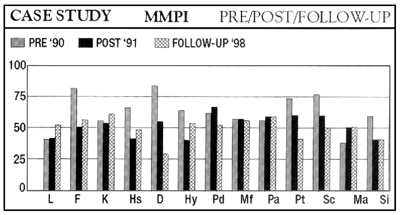
MMPI-2 (see Fig. 13.2) showed no clinical diagnosis on Axis I and
personality disorder NOS on Axis 11. There was a major drop in the
Depression scale from 81 to 53. She was no longer suicidal. She showed the
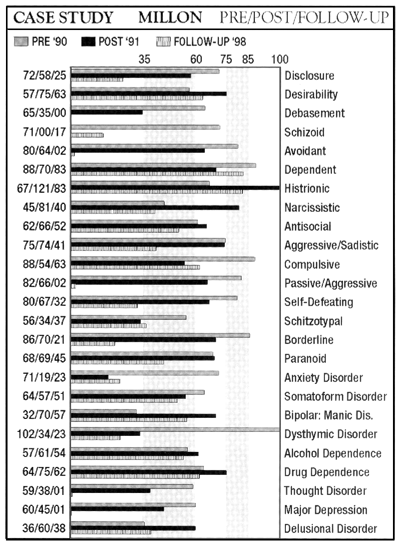
same shifts on the Millon II with the Dysthymia scale dropping from 102 to
34, and Borderline dropping from 86 to 70. These scores also fit our
impressions of her. Perhaps most noteworthy was her pretreatment Millon II
score of 71 on the Schizoid scale reflecting her unwillingness to process
any emotional content. Her post score of 00 on this scale suggested that she
now could be "emotionally available" for further therapeutic treatment. Her
elevation on the Histrionic scale on the post-treatment Millon II (see Fig.
13.3) may be perceived as a positive developmental step, suggesting she was
now not blocking her emotions. She was still slightly high on Psychopathic
Deviate on the MMPI-2 scale. We often see this scale remaining slightly high
after EEG feedback training, and this could be related to a developmental
stage of owning one's own creativity and independence. She came in for five
"booster" sessions during the next year when she felt stressed and sensed
that she was losing some of her inner peace and connection to herself.
After
the completion of the neurotherapy program, B.K. reported nO craving for
alcohol and said she was able to face her emotions. She then went through
our center's PAIRS program, which is an intense 120-hour group program
extending over 4-5 months, attended by couples and singles. The focus is
predominantly on the relationship with one's self. It is usually a very
emotional experience, and our belief is that she could not have gone through
this if she had not completed the EEG feedback training. During this
extensive period of time, she only left the room and the group one time. She
was gone for about an hour and returned. She shared with the group that she
had left, and told them that she knew why she had left-it was the weekend on
sexuality. She reported, quite proudly, that she knew why she had left and
that, though she had left, she never left the building and had returned.
FIGURE 13.2
Pre-, post-, and follow-up testing graph of the MMPI-2 of B.K.
FIGURE 13.3
Pre-, post-, and follow-up testing graph of the Million II of B.K.
B. FOLLOW-UP
<top>
Several years later I saw B.K. at a lecture and she came up to speak. She
appeared healthy and well groomed. She was still overweight, but said she
was no longer bingeing on food and had remained sober. She said she was in
an incest survival group and that memories were still surfacing, but when
they did she would feel sad and grieve for a few days and then be able to
let the associated negative feelings go and move on with her life. She
reported a good relationship with her husband and claimed to be doing well
on her job.
At the
time of this writing she agreed to do an almost 8-year follow-up on her
MMPI-2 and Millon II personality inventories (see Figs. 13.2 and 13.3). All
scales of the MMPI-2 now are fully within normal limits. The computerized
printout stated that this clinical profile is within normal limits, with no
clinical diagnosis provided on either Axis I or Axis 11. The Psychopathic
Deviant score had dropped to within normal limits, and the Depression scale
had dropped from its original T score of 81 to 30. The Millon II follow-up
showed that the Borderline scale (originally scored 86) now is 21; Dysthymia
(originally 102) now is 23; Debasement is 0; Avoidant and Passive-Aggressive
scores are 2, with Thought Disorder and Major Depression scores of 1. B.K.
has continued her sobriety and her path to health.
B.K.'s
case involves many aspects of the healing commonly seen using this protocol
and illustrates many points, including what have been called the "witness
consciousness" and the "resource self," which were described in the
preceding section.
Neurotherapy home page | A
Typical Session | FAQs | Published
Articles |